The Tyranny of the Past

Yesterday I spent a little time logging into what seems to have been an all-day conversation about the Israeli-Palestinian conflict on Clubhouse. The discussion was, of course, prompted by the recent Hamas rocket attacks and the Israeli bombings that murdered hundreds of civilians. But it was really a lot of venting about the endless history of grievances. It seems there is no statute of limitations on any sentence that begins “What about…”

I was too unsure of myself to speak up in that forum. I’m hardly an expert on the situation. I had no Jewish education; in fact, I didn’t know our family’s proper last name until I was in my late teens or early twenties. Kutisker. Not Browde, which was an Ellis Island misspelling of Braude, my paternal grandmother’s maiden name. Kutisker was my father’s last name. It was also the name on Nazi propaganda posters. “The Jew Kutisker…” with a photo of my great grandfather, who had been accused of financial crimes.

My family history is the classic Jewish Diaspora story. Flight from oppression and genocide; many dead, many others, like my father, who went through life with what I suppose might have been PTSD, which left him sometimes tone deaf to the suffering he inflicted on others.

But here we are now. Yesterday‘s conversation was frustrating to listen to. It’s not as if the state of Israel was founded on uninhabited territory. People lived there. People lost homes and communities. People who had had nothing to do with the Holocaust.

And here we are now, almost 75 years later, arguing on Clubhouse. One Palestinian woman protested that any time she criticized Israel, she was called “anti-Semitic.” “I’m Semitic too,” she said, her frustration mounting. Someone else corrected her, saying the term has now become widely understood to mean anti Jewish. Another woman kept bringing up 7 million. Yes 7 million Jews, And Armenians. And Cambodians. And the native tribes of North America. The history of our species is pretty abysmal when it comes to the sanctity of life.

But haven’t we evolved, learned the futility of hatred? Why not look forward? Why not ask what vision Palestinians and Israelis have for the future (taking the annihilation of each other off the table). What if you had to imagine an outcome that would enable every person to have equal human rights, equal self determination, equal access to resources and opportunities?

David Rock, who founded the Neuroleadership Institute, developed a great heuristic to explain core human needs. He calls it the SCARF model. Status, Certainty, Autonomy, Relatedness and Fairness. If we made the elements of the SCARF model our core values, wouldn’t we be able to come up with a humanistic solution?

Is this America?

My grandfather was 4’11” tall. From a shtetl someplace in Belarus. When he came to the United States, he worked as a Hebrew teacher, a milkman, a factory worker. He joined Workers of the World. He and his brother moved to Cleveland and got jobs in a plumbing supply company. And when World War 1 began, Grandpa refused to register for the draft. Not because he wasn’t willing to take on the danger, but because he believed he had more in common with fellow workers across the world than he had with those leaders who wanted to enlist young men to kill each other. He didn’t buy into the morality of fighting to the death against other working men, regardless of their nationality.

It was only a symbolic act. He was too short and wouldn’t have been accepted into military service anyway. But he wanted to make the point. He wanted to reject the war rather than wait for the war to reject him. The infraction landed him in jail for a year. He was fine with the jail sentence; he knew it was a consequence of his own actions and he was willing to pay the price. In prison he learned English and, at the suggestion of Emma Goldman, became a lawyer. He attended Fordham Law School as a special student, having never gone to high school or university. He graduated, passed the New York bar on his first try and set up his law practice.

He has always been my favorite member of my family; he was my hero, my teacher and my safe haven. He set the standard for courage.

So when I look at the sleazy lack of courage in the Senate today, I’m ashamed and disgusted. Who cares if you lose an election? Are you really willing to lie? Are you so corrupted by your privilege that you would abandon any pretense of a moral compass?

Being a senator isn’t the only job in the world. Surely you know how to do other things. And it’s hard to respect people who put their temp jobs ahead of principles.

Irrationalities

Here are some of the many things about other people I don’t understand:

1. I hear people – mostly Christians, from what I can tell – talking about religious freedom. But as far as I can tell, they are the only ones who want to impose their beliefs on the rest of us. What’s the rationale? Wasn’t the separation of church and state a principle designed to protect people from different philosophical orientations from being dominated by any nationally ordained philosophy?

2. Why do the same people who believe that abortion is murder support unrestricted gun ownership, including assault weapons, and the death penalty? I can understand an objection to abortion, although I don’t see how small government claims the right to regulate what goes on inside a woman’s body. But I can’t understand people who believe in the sanctity of life believing that they should be armed to the teeth against those with whom they disagree.

3. Why do smokers not seem to recognize that throwing cigarette butts on the street is littering? And why don’t they get tickets for it?

4. Why do progressives not understand the alarm bells (irrational as they may be) that go off in conservatives’ heads when they hear the word “socialist?”

5. And why are those anti-socialist conservatives unable to distinguish between socialism, which is really about mutual interdependence, with fascist communism, where an autocratic leader controls all the mechanisms of production and is not accountable to the people? Churches are socialist – they pool money for the good of their communities. Medicare is socialist. The construction of roads; investments in research to develop a COVID-19 vaccine, and military support are all socialist inasmuch as they’re collective investments in what has been deemed the good of the broader community.

When the retaining wall crumbles

The flood waters are rising. I’m flailing around in the decades of repressed feelings about the many creepy, experiences I had as a child, a student and a young woman. One incident in particular troubles me. I was in my early teens. I went to Omaha to visit Kathy, one of my best friends from summer camp. I spent several days with her family between Christmas and New Year’s. They lived in a comfortable 3-bedroom house with a finished basement, on an old, tree-lined street. At the top of the stairs to the second floor, there were four doors. Starting from the left, going clockwise were her brother’s room, her room, her parent’s room and – on the right, the bathroom. One night I was heading back from the bathroom to Kathy’s bedroom when her father kind of accosted me. Didn’t say anything, just hugged me way too tight for no reason, kind of pulling me towards him, mashing me into his body. I slipped out of his grasp and into the safety of Kathy’s room.

The next day, I was in the study, just off the living room, calling my parents, when he came up behind me and again mashed himself into me. He was just so creepy, I couldn’t stand to be near him. Shortly after the second incident, I joined Kathy and her mother in the kitchen, where they were making a lemon jello cake. Her mother asked me to run down to the basement pantry to get another can of something. I was about to go downstairs, when her father came into the kitchen and volunteered to help me find it. I had no words for the wave of aversion that came over me, but I knew I was going downstairs with him. I said I had to go to the bathroom really bad, and ran upstairs.

It was decades later before I said anything. I had called Kathy for her birthday. Turned out she was I bad shape, seemingly in the midst of a breakdown. In the course of the conversation, I asked her if her father had ever molested her. “Why do you ask?” she replied. “I didn’t want to relate my experience, so I just said I didn’t know why exactly, but something she had said made me wonder. “My therapist just asked me the same thing,” she said, but she went on to dismiss the theory, insisting nothing had ever happened.

That was it. I never mentioned my experience to her, although I had spoken of it to a mutual friend. Kathy and I never discussed her father again. In fact, we haven’t spoken for years, and to this day, she says she insists I made the whole thing up. But no. I didn’t. Her father was a perv. And if he did it to me, I’m guessing he did it to other girls too.

MeToo

The flood of people speaking up about sexual assault and sexual harassment has been troubling me. I grew up with so much of it. I was such a trusting, naive child. Even into young adulthood. It was a joke. I was a classical guitarist – more or less accidentally. I was singing in coffee houses when I was in college and heard there was a guitar teacher at Mount Holyoke College. It was classical – and I had just started learning to play folk and blue grass. But what the hell, I signed up.

Something clicked. Having to practice the guitar was a perfect excuse for getting out of awkward social encounters, for blocking out my mother’s suicide threats. It was safe. Two hours of scales and arpeggios every day. So I got good at it fast (for someone who began an instrument at age 18).

It was a win-win for my two paradoxical needs: applause and isolation. So, 18 months after I started to study, I headed to the Aspen Music Festival. It was scary: I only knew about 4 short pieces on the guitar and the place was teeming with world class musicians among both the students and the faculty.

The classical guitar maestro was named Oscar Ghiglia – and we all worshiped him. It seemed the norm within classical music: Great teachers had utterly devoted students.

One afternoon, the third summer I was in Oscar Ghiglia’s master class, I was sick in bed and the entire class came to the place I was renting in Aspen Square. We hung out for a while, and when people left, Oscar stayed behind and literally jumped me. I was shocked, confused. I resisted at first but eventually gave in. But after that, when he would come banging on my door, I would bolt the door, lock myself in the bathroom and wait for him to go away.

Why didn’t I stop studying with him? Reasonable question. I wanted to get good. I wanted the approval. I went to Italy for another master class and competition. We had fist fights when I refused him, so he took away my scholarship.

Finally, the last straw came when he burst into my little room in Gargnano and forcibly raped me. “There, don’t you feel better?” he smirked as he rolled off me. It was September, 1980. My mother was dying of cancer – and his wife was visiting my mother. I told him if he ever touched me again, I would tell his wife, and I left town the next day.

I never talked about it with the other women who studied with him, but I can’t imagine that my experience was unique.

Vindication 2009

Dear Michael,

Over the weekend our team met with Beth to review her findings and recommendations for the Millennium Village Project in Micheweni District, and we are all confident that we have identified the best possible path forward to fully launch the MVP in Micheweni District.

First though, I want to stress that Beth did an extraordinary job on this project, bringing a depth of insight, cultural sensitivity and pragmatism to the task and earning universal praise from the government of Zanzibar, the United Nations and several of the world’s leading development experts. In fact she far exceeded our own very high expectations.

Based on Beth’s report and our experience launching projects involving multiple high-level stakeholders, we propose to move forward to establish the Ivo di Carneri Foundation’s Public Health Laboratory as the operating NGO on the ground. They will handle all the project administration and provide technical backstopping in the health sector.

The PHL’s longstanding relationship in Pemba, its experience in managing large, globally funded projects, its strong administrative organization and, most importantly, its strong reputation with both the Zanzibar government and the people of Pemba will allow us to move much more quickly to achieve our shared objectives: to help the people in the village of Kiuyu Mbuyuni begin to climb out of extreme poverty and achieve the Millennium Development Goals.

Technical backstopping and guidance will be provided by the MDG Centre in Nairobi, with operational oversight from Millennium Promise. The MDG Centre, headed by Belay Ejigu Begashaw, one of the world’s leading agronomists, is home to a team of scientists and policy experts, all of whom are Earth Institute employees.

Project governance would be handled by a high-level steering committee, comprising you; Belay Begashaw, Director of the MDG Centre; Lorenzo Savioli (founder of the PHL and the head of neglected tropical diseases at the WHO), John McArthur, CEO of Millennium Promise; and me.

The advantage to this arrangement for KPMG is that you avoid the burden and expense of managing a new NGO from New York or London; you can accomplish much more by leveraging an experienced team of administrators who know how to get things accomplished in Pemba; and you will have an infrastructure on the ground to support your people if you decide to send volunteers to help with some of the project work, such as small enterprise development.

Therefore I suggest the following next steps:

  1. We immediately develop an MoU between MP, EI and the MDG Centre, PHL/IdC and KPMG spelling out the roles and responsibilities of each party
  2. We revise the newly hired Team Leader’s contract to have him report to Belay Begashaw and Steve Wisman (director of operations for Millennium Promise) through the PHL (He should begin work on October 19th with a week-long orientation with Belay and his team in Nairobi)

I have asked Beth to continue work as a consultant on this project for at least one more month to ensure that we are able to fully capitalize on the great work she has done so far and the strong relationships she has built within Tanzania and Zanzibar.

I look forward to seeing you later this month in Barcelona and hope that by then we are able to celebrate the signing of an agreement enabling us to achieve our shared vision: working side-by-side with the people of Micheweni District to escape from extreme poverty and achieve the Millennium Development Goals.

Warm regards,

Jeff

Going Corporate

Many years ago when I was a budding and impassioned young painter in junior high school art classes, a teacher found me staring morosely at a canvas on which I had just made a giant mistake. “It’s ruined,” I said. He looked at the canvas, unsure which from my young perspective comprised the offending colors or shapes, and said, “There are no mistakes in art. At every moment your canvas – your landscape – is changing. Just use what you see now.”

And therein lay a bit of wisdom I would forget and relearn many times over the next 40 years. I made many seemingly wrong turns and odd choices in my life. As my peers honed in on clearly defined goals early in their careers – becoming well-known orchestral musicians, doctors, attorneys or senior executives – I seemed to flounder. I tried many things with a modicum of success: working as a singer, a classical guitarist, an actress, a playwright, a journalist and a teacher. I volunteered at homeless shelters, launched a not-for-profit and became a leader in a Buddhist organization.

But suddenly, 18 years ago, I seemed to veer sharply off-course when a temp assignment as secretary to the chairman of a large insurance company morphed into a job as a communications consultant.

Nothing in my life had prepared me to be a communications consultant. I didn’t know how to be a consultant. I didn’t want to be a consultant; I didn’t want a day job at all – and certainly not in an insurance company. What could be duller? I browsed through the files of consultant reports from Bain, McKinsey, Mercer, and Booz Allen and found the jargon stultifying, almost incomprehensible. In fact, the entire corporate world seemed alien: rigid and grey, evoking the maddening stasis of a fogged in airport.

But there I was, the temp summoned into the chairman’s office. “You have a real future here,” he said. “Tell me what you want to do and I’ll put you anywhere in the company you want to go.”

Home to finish my novel was clearly not an option.

So I took a stab at a better answer, “I don’t know for sure what I want to do, but one thing that bugs me here is the way people write – especially to customers. It always sounds so phony – not like a human being writing to another human being. Half the time I can’t make out what anyone’s trying to say. Do you want me to fix that?”

“Yes,” he said. “In fact, we’re just about to hire a communications consultant. So fine, it’ll be you.” And there it was: the giant mistake on the canvas: my first, full-time, salaried corporate job.

What I learned there – and continued to learn as I made my trek from the insurance company to grad school for a degree in creative writing, back to corporate life as a communications manager at an acccounting firm, then on to management consulting – is that art exists first within perception. Art is in the way we hold up a frame to some aspect of life – the way we see the canvas right in front of us – and how we derive meaning and build upon that which we perceive.

But mere framing is not enough. In his critical writings (Theory of Fiction, ed. James E. Miller, Jr., p.158), the novelist Henry James discusses the art of framing, noting the difference between a mere “slice of life” and a true work of art, which emerges when one is able to find the unity within diverse bits of data or experience: “in other words…the point at which the various implications…most converge and interfuse.” That, James says, is what shapes a work of art and comprises “the very vessel of [its] beauty – the beauty, exactly, of interest, of maximum interest, which is the ultimate extract of any collocation of facts, any picture of life, and the finest aspect of any artistic work.”

Despite James’ overwrought prose, something resonates: The beauty of maximum interest. As a writer, a coach, a consultant or an artist, the challenge is the same: to help others see with maximum interest, investigate, appreciate and make the greatest possible use of what they know and what they see.

Celebrating

A year of running. 1849.29 miles in 296:06:32. Average pace = 9:36 minute mile. I beat last year’s distance by 38 miles and bested my average pace was 8 seconds per mile.

Still, I worry that the fastest miles may be behind me. I’m not sure. Right now I’m running slightly slower than the year’s average pace and wonder if I’m gradually aging out of my era of frequent PRs. The only way to know for sure, though, is to work like a demon to see how much more is in there. Strength training, focus on efficiency, more speed work – and most of all, more mental toughness.

“It’s supposed to be hard.” That’s the mantra that gets me up tough hills and fast intervals. “It’s supposed to be hard.”

Sometimes that works. Sometimes it’s just the joy of watching the first rays of light spilling across a dark morning sky, catching the red-tailed hawk in flight. That stuff.

Most of all, though, when I think back to this year, I will be grateful. For the joy of running in Central Park and for so many things: my truly wonderful job and my smart, talented, convivial colleagues at Mercer; Harley, my training partner, who has seen me through ups and downs, fast finishes like my 4-minute PR at the NYC Half last March and  maddeningly slow ones, like my disastrous NY Marathon; my friends and neighbors; my nephews and the rest of my crazy family – with all its strange transformations; and my Buddhist practice, which never fails me and constantly reminds me to appreciate every nanosecond of life.

And despite anything I said above, I’m still hoping to shave more of those nanoseconds off my best times. I’d rather spend them on the far side of many finish lines to come.

252690_188337251_XLargeHappy New Year everyone!

Persistence

I really didn’t feel it yesterday morning when I lined up for the race. I had arrived way too early, excited about my “local competitive” status. I was expecting something more than what I found – an open area, an open tent covering the food. And runners lounging around on the grass. But the bathrooms were clean and the waits weren’t so long. And no lining up in the corrals 50 minutes before the start. Just an escort directly to the line with only 20 minutes to go.

We went to the green start – the lower level of the Verrazano Bridge. Not the place for the awe-inspiring iconic start. Just the pounding of feet and Garmin unable to find a signal. The runners around me were fast. I had to try to keep myself in check. But Garmin wasn’t much help, vacillating between 7:30 and 14:00 pace. I knew I was running steady but with all the runners passing me, it felt as if I was going backwards. I just kept going with my eyes fixed on daylight ahead. Finally out into the open. Some faint superstition was bugging me. The only other time I had a green start, under the bridge, was in 2013. That was also the only time I started but didn’t finish the race. And once again I was feeling the uneasy burbling of stomach problems.

I was determined to keep myself on an even pace – nothing above 9:20. Sadly, unlike last year, when the wind and my months of training seemed to buoy me, keeping to a 9:20 – 9:25 pace wasn’t even easy. I didn’t feel much tendency to speed up. And after about 7 miles, I really needed a pit stop. I ran for the nearest. No line – that was good. But inside I found a truly foul mess of a place, a stopped up urinal almost overflowing, garbage stowed inside, no toilet paper (I had some with me, having learned the hard way). Pooped and ran, hoping no one else would make the mistake of opening that door.

90 seconds lost. I calmed myself, picked it up a little, but felt that I was going to have more stomach problems soon. Gurgling and chugging along. Arms ok, stride ok. Off pace, though and not really feeling it. The first half didn’t fly by, it was a slog. I repeated my mantra, “strong mind, strong heart, strong body.” But I knew my best long runs this year hadn’t been nearly as strong  as my best runs last year. I didn’t go in with the confidence that I was ready.

Still, the sudden appearance of the 59th street bridge caught me by surprise. I must have drifted off. I had done that bridge backwards and forwards and I knew it would be hard. All I had to do was keep going. And find a loo. I really had to find a loo. But that would have to wait until First Avenue.

Too late.

By the time I found a loo, just after the turn onto First, I was a mess. Called Harley, my training partner. I really wanted to drop out, but instead, I did my best to clean myself up. There were people out there cheering for me. My team from work. My friends. People I didn’t want to disappoint. And then the intrinsic motivation kicked in: Even if you’re not going to have a PR, you have a chance to prove to yourself that you have a strong mind, strong determination and – as we Buddhists say – that “never-give-up” spirit.

Another 6 minutes lost. So that was going to be it. I ran up First Avenue. Just needed some Gatorade. I was pretty sure I was seriously dehydrated. I had to take my time. I was getting dizzy. There was my friend and former coach, Susanne, calling to me. Still had the nagging thought that I could drop out and go home. But then the Willis Avenue Bridge was right in front of me. I reminded myself that the only way to make sure I finished was to run as far away from home as possible, so I’d have to run back.

How well I know that part of the course. I always practiced it: up First Avenue and across the Willis Avenue Bridge. I love running in the Bronx, past that old, stately church, the housing projects, car repair shops, taiko drums, and across 135th Street to the Fifth Avenue bridge. But whoa, I was really dizzy. Stopped to walk and almost lost my balance. Another runner saw my wobble and stopped to see if I was alright. She wanted to take me to medical. I didn’t want her to wreck her race. I talked her into running on, but then, when I saw the medical tent, I had to stop. I asked for salt. They checked my pulse. It was ok, they said. I sat for a few moments eating salt and drinking a little water and then said, I’m finishing. No matter what!

Two more minutes lost.

So off I went. Harley would be waiting for me on Fifth Avenue. And there was Elyse and the Merms yelling encouragement at Marcus Garvey Park. Then Mary Wittenberg at a water station. She called out to me, saying I looked great (although I surely didn’t). But no matter. One foot in front of the other. And then there was Harley, as promised, in her pink jacket. She jumped in and ran (and walked) with me, just coaxing me along. I had to walk a lot then. I was just trying to finish. There was no longer any hope of picking up the pace again. My quads were like rocks. Then we were in the park. There was Jon with the the kids. I was so excited to see them, I got a slight burst of energy. Then we just had to make it out of the park and across 59th Street. Harley stayed with me right up to the turn back into the park. I just had to finish. No matter what, I kept telling myself.

People have bad races. Sometimes they drop out. But Meb finishes. I thought about Meb. I thought about the other great runners I knew who had finished bad races. My orthopedist told me he finished a marathon a few weeks ago and was 22 minutes off his PR. Sometimes it’s enough to finish with your head held high.

So I did.

For a few hours I thought, ok that’s it. No Boston for me; I’m done with marathons. But this morning I woke up and had to keep myself from putting on my running shoes and heading out to the park. What is that? Determination. I can do better. And I will.
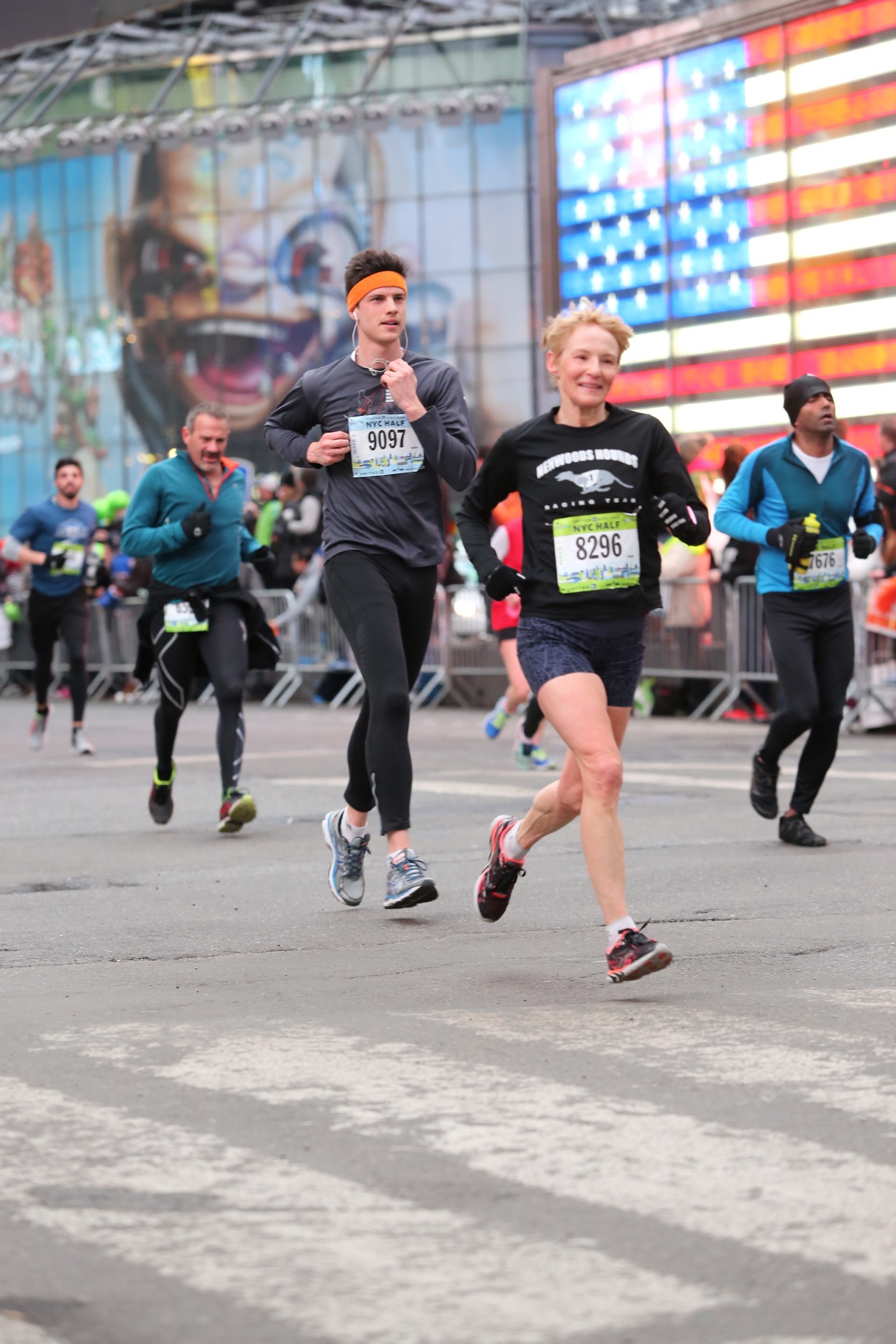
Just Another Sunday Run

I got great final advice from my coach, John Henwood, yesterday. In fact, it’s the same advice he’s given me for years. But this year, I think I’m ready to really heed it: Keep to your goal pace. Don’t let yourself speed up. And what if you find yourself running too fast? Slow down (duh). Easier said than done.
I took two days off from work to rest up – and I’m already stir crazy. I’ve checked the hourly forecast, I’ve pinned my bib on my shirt, I’ve lined up my GUs and my UCAN. I’ve checked my work email several times (and it’s only 8:40 am). I’ve done the crossword puzzle.
Now what?
Now it’s time to remind myself that every run is another adventure. That’s all. It’s not my profession and, despite my type A tendencies, it doesn’t go on my “permanent record” (whatever that is) any more than the sweet potato I ate for dinner last night. Except, of course in the spiritual sense that everything we do, everything we think, every intention is a cause. And every cause generates an effect. The effect of running? Happiness. Health. An evocation of simplicity, of being part of nature, one of the many species in the park. Raccoons, hawks, sparrows, cardinals, dogs, cats, humans, ferrets, squirrels.
That’s the part I like the best. And the sensation of running – when it’s going well and my gait feels smooth and unfettered. I used to feel the same way about singing and, less frequently, about playing classical guitar. Those moments that Otto Scharmer of MIT describes as “presencing.” He defines it as “a movement where we approach ourselves from the emerging future.”